
Creative Disruption: Activating Holy Imagination
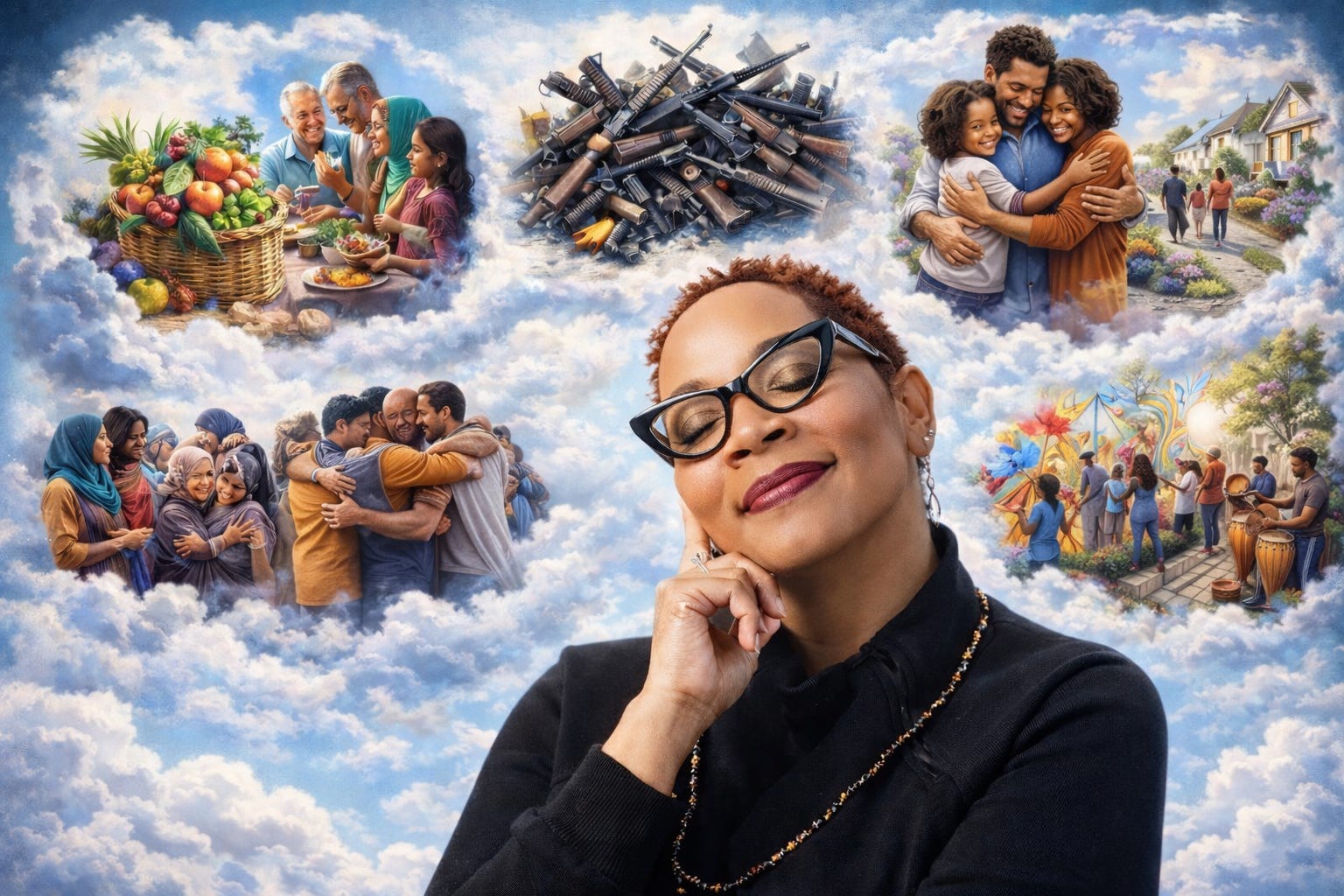
Dreaming a new world

By Rev. Dr. Shelley Best
The Future is first Imagined before it is built
There are moments in history when societies begin to feel stuck. Institutions that once promised progress begin to feel rigid. Public trust erodes. Systems that were designed for another era struggle to respond to the realities of the present. In these moments, many people assume that meaningful change must come primarily through politics or policy. Yet history shows something deeper and more fundamental. Before institutions change, imagination changes. Before laws shift, culture shifts. The future is first imagined before it is built.
This insight lies at the heart of what I call Creative Disruption.
Creative Disruption begins with a simple premise. Creativity is not merely personal expression. Creativity is a force capable of transforming systems, communities, and leadership itself. Artists, storytellers, innovators, and cultural workers are often treated as peripheral figures in public life. They are invited to decorate events, beautify spaces, or interpret movements that others have already begun. Yet throughout history, creativity has played a far more central role in shaping the direction of societies.
Creative Disruption recognizes that institutions and social systems naturally become rigid over time. Policies grow stale. Narratives become fixed. Power structures begin protecting themselves rather than serving the public good. When systems harden in this way, change rarely begins inside those systems. Instead, transformation often begins at the edges of society where artists, visionaries, and cultural innovators are willing to imagine what does not yet exist.
Creativity has always been deeply connected to social transformation.
Creative work introduces alternative stories, alternative images of the future, and alternative ways of organizing human life. It expands the boundaries of what people believe is possible. For this reason, creativity has always been deeply connected to social transformation. It operates not only in galleries and studios but also in the moral and imaginative life of communities.
One of the central principles of Creative Disruption is that imagination precedes change. Every significant transformation begins with someone who can envision a different world before others can recognize it. Before laws change, someone must imagine a society shaped by different values. Before institutions reform, someone must see structures that do not yet exist.
Artists have often performed this role instinctively. Through images, music, literature, and performance, they reveal possibilities that political systems have not yet recognized. What begins as creative expression frequently becomes the blueprint for social change.
But Creative Disruption also invites us to think about imagination in spiritual terms. Throughout history, spiritual traditions have spoken about the importance of prophetic vision and moral imagination. The prophet sees what others cannot yet see. The poet gives language to truths that communities have not yet been able to articulate. The musician awakens emotions that help people recognize their shared humanity.
I describe this deeper dimension as holy imagination.
Holy imagination is the capacity to envision a world shaped by justice, belonging, and love
Holy imagination is the capacity to envision a world shaped by justice, belonging, and love even when the present moment seems resistant to those values. It is the spiritual courage to imagine that communities can heal, that systems can be transformed, and that new forms of leadership can emerge. Holy imagination is not naïve optimism. It is disciplined hope rooted in creativity and moral vision.
Creative Disruption is one of the ways that holy imagination becomes visible in the world.
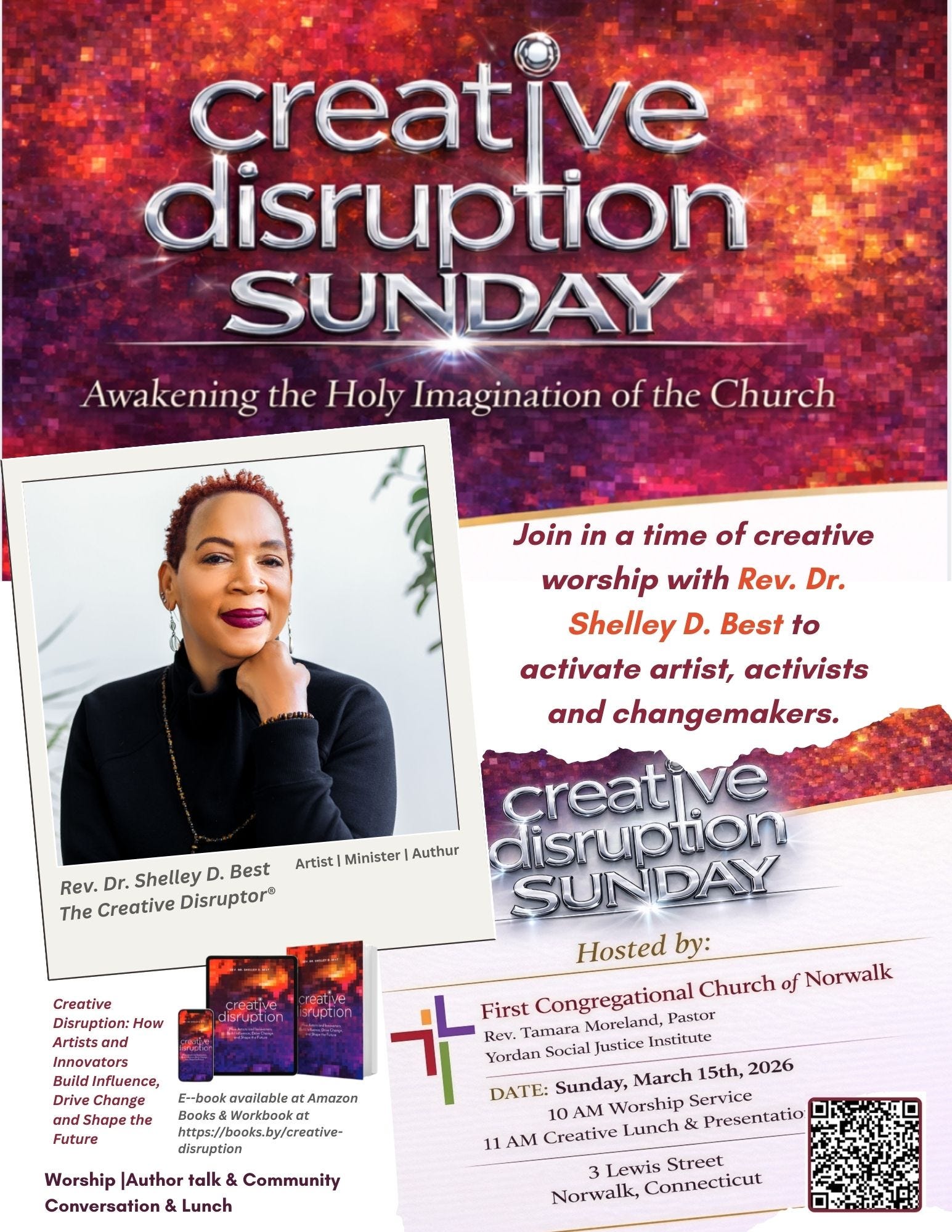
Join with Rev. Tamara Moreland the members of First Congregational Church of Norwalk on March 15, 2026 for Creative Disruption Sunday, a time to awaken holy imagination.
When artists reclaim erased histories, they restore the dignity of those who were silenced. Intellectual leaders such as W. E. B. Du Bois reshaped how a nation understood race, democracy, and liberation by expanding the moral imagination of the public. In New England, the abolitionist James Mars preserved the truth of his own life under slavery through written testimony, ensuring that the realities of oppression could not be erased from history.
Their work reminds us that storytelling itself can be a form of liberation.
Creative practice also builds the spaces where communities can rediscover one another. Murals, music gatherings, storytelling circles, and artistic collaborations create environments in which people encounter one another differently. In these spaces, people listen, reflect, and imagine together. Trust can begin to grow. Shared identity can emerge.
When communities create together, they rebuild relationships that have been strained by division
When communities create together, they often rebuild relationships that have been strained by division and mistrust. Creative ecosystems can generate cultural vitality and even economic renewal. Artists become entrepreneurs, neighborhoods rediscover a sense of place, and communities begin to flourish in ways that traditional systems often struggle to produce.
At the center of this work is what I call the Creative Disruptor®
A Creative Disruptor is someone who uses creativity as a method of leadership and transformation. This person might be an artist, minister, educator, technologist, or organizer. What distinguishes the Creative Disruptor is not a professional title but a particular orientation toward the world.
Creative Disruptors see possibility where others see permanence. They use creativity to expose injustice while also imagining alternatives. They build spaces where new communities can form and where imagination can become collective rather than isolated. In doing so, they often shape the cultural direction of society long before formal institutions respond.
The importance of activating holy imagination feels especially urgent today. The modern world faces overlapping crises that include political polarization, environmental instability, rapid technological change, and increasing social fragmentation. Many institutions struggle to respond effectively because they were designed primarily to preserve stability rather than adapt to complexity.
Creativity offers a different path forward. Creativity encourages experimentation, collaboration, and moral imagination. It allows communities to explore new possibilities without being confined by the limitations of existing systems. In this sense, creativity becomes a form of social intelligence that helps societies navigate uncertainty.
Creative Disruption ultimately describes a practice as well as a philosophy. It is the practice of using creativity, storytelling, art, and innovation to challenge stagnant systems and generate new possibilities for community flourishing and social transformation.
When people activate holy imagination, they begin to see the world differently. They begin to recognize that the future is not predetermined. It is shaped by those who are willing to imagine something better and then work together to create it.
Readers who want to explore the full framework behind this idea can find it in my book, Creative Disruption: How Artists and Innovators Build Influence, Drive Change, and Shape the Future.
Books.by
https://books.by/creative-disruption
Amazon
https://www.amazon.com/Creative-Disruption-Artists-Innovators-Influence/dp/1634898230
The future will not be created by institutions alone. It will be shaped by imagination, courage, and communities willing to create something new.
Belong deeply. Rise boldly. Thrive fully. Disrupt to create.